
Still running your shifts on a spreadsheet and WhatsApp? Seven signs it is costing you money
Almost every business under twenty people builds the rota the same way: a spreadsheet inherited from someone else, an export to PDF and a photo dropped into the team group. It works. Right up until a Saturday when two people are missing from the bar and nobody can explain why.
There is nothing wrong with a spreadsheet. It is fast, everyone understands it and it costs nothing. The tool is not the problem. What happens around it is. The rota comes out of the spreadsheet, turns into a PDF, the PDF goes into the group chat, and from there it starts a second life nobody controls. Someone asks for a swap in a private message. Someone else never sees the post because forty messages landed on top of it. The manager rebuilds the sheet on Thursday and sends the good one, but three people are still working from Tuesday's.
This article is not about spreadsheets being bad. It is about spotting the moment that routine costs you more than it saves. Seven fairly specific signs: if three or more sound familiar, the problem is no longer how you organise, it is what you organise with.
The routine almost everyone repeats
Drawn out, the usual process has five steps: open last month's sheet, copy the columns, change the names by hand, export to PDF, post it in the group. Every step looks harmless. Together they create three problems that stay invisible until they blow up: there is no single valid version, there is no record of who agreed to what, and nobody's hours add up anywhere.
Here are the seven signs, roughly in the order they show up.
Sign 1: two versions of the rota are circulating
Easy test: ask three people what time they start next Saturday and check the three answers against your sheet. In teams that have been running the spreadsheet-PDF-chat routine for months, matching answers are the exception.
It happens because a PDF you have sent cannot be corrected. When something changes, the only option is to send another file, and now both live in the group. Anyone scrolling up for their shift finds the first one they hit, which is not always the right one. Nobody is being careless here: the format itself allows two truths to exist at once.
Sign 2: someone says “I didn't know I was working”
This is the most expensive symptom of all, because the cost is not lost time, it is an uncovered shift. And it is rarely a lie. The message landed in the group on a Sunday night between photos and voice notes, or it landed while the person had no signal, or they read it on the bus and never wrote it down.
A group chat cannot tell the difference between “this is an important notice for you” and “this is a conversation”. Everything weighs the same and everything gets buried at the same speed. A rota published in an app shows up in each person's own calendar, with their shift and their hours, and it is still there three weeks later without anyone searching for it.
Sign 3: the rota depends on one person
If the manager is on holiday and nobody else can touch the rota, you do not have a process, you have a dependency. It usually shows in August, when the sheet “is on their laptop” or “is in their Drive”, and whoever covers ends up building a new one from scratch with different criteria.
That dependency also has a price in hours that rarely gets counted. Ask managers in hospitality or retail and building next week's rota takes four to six hours: working out who can do what, fitting days off around each other, redoing it when two people ask for the same day, and sending it round again. The sums are further down.
Sign 4: nobody knows how many hours each person has done
In a well-built spreadsheet the hours add up with a formula. In practice that formula breaks in the first month: someone inserts a column, someone types “9-5” instead of a real time value, and the total stops being true. From then on, the only honest answer to “how many hours have I done this month?” is “let me check”.
The problem bites twice. First when somebody has worked over their contract and you owe overtime you had not budgeted. Then when somebody has worked under it, the gap builds up, and next month you have to hand them shifts that do not suit them. Both disappear when whatever builds the rota knows each person's contracted hours and refuses to go past them.
Sign 5: swaps are agreed in private
“You take my Saturday and I'll take your Thursday.” On paper, it is ideal: the team sorts itself out. In practice the manager finds out at ten on Saturday morning, when the sheet says one name and the floor has another.
Swaps are not the problem; swaps that leave no trace are. A change agreed in a private chat is not on the rota, does not count towards anyone's hours and cannot be checked when someone disputes their pay. When the swap is requested inside the app, you approve or reject it, the rota updates for everyone, and there is a record of who asked and when.
Sign 6: the clock-in data and the rota do not match
Most countries now expect some form of working time record. In the UK, employers must keep records adequate to show compliance with the Working Time Regulations. Across the EU, the Court of Justice ruled in 2019 that member states must require an objective, reliable and accessible system measuring daily working time. Countries such as Spain turned that into a duty to keep a daily record for four years, with fines for employers who do not.
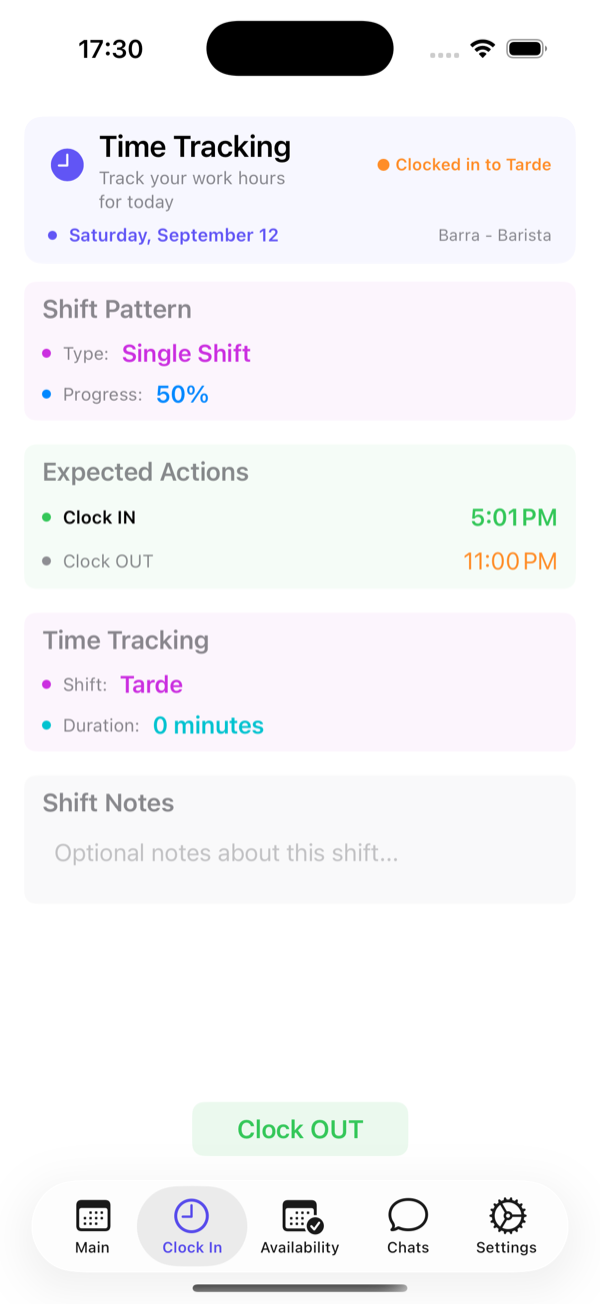
Most businesses already have something to clock in with. What almost none of them have is that something talking to the rota. If clock-ins live in one app and shifts in a spreadsheet, month end will not add up, and reconstructing by hand why someone clocked two extra hours on the 12th is half an afternoon of work. When the planned shift and the real time sit in the same place, the gap shows up on its own.
Sign 7: the whole job lives in a personal chat
This is the sign people look at least and the one that can hurt most. Running shifts over WhatsApp means instructions, changes, arguments and your staff's contact details sit on personal phones, outside any company control. If there is a dispute tomorrow, those conversations turn up as evidence, and you do not get to choose which ones.
Three things are worth being clear about. Unless on-call time has been agreed and paid for, nobody has to answer work messages outside their hours. Adding someone to a group shares their phone number with everyone else in it, which is personal data you cannot pass around freely. And when something inappropriate is posted in that group, the employer's duty to act starts the moment it becomes aware, even if a supervisor set the group up on their own initiative.
You do not need to ban the chat. You do need to take management out of it: shifts, swaps, absences and notices. Let the chat go back to being where people talk, rather than the system they work in.
The numbers, without exaggerating
Take a twelve-person business with two shifts a day. The manager spends five hours a week on the rota, corrections and messages included. Forty-eight weeks a year makes 240 hours. At £15 an hour of cost to the business, that is £3,600 a year of someone's time who is paid to do something else.
| Item | Amount | Yearly cost |
|---|---|---|
| Building and fixing the rota (5 h/week × 48 weeks) | 240 h | £3,600 |
| One uncovered shift a month from a notice nobody read | 12 shifts | ~£1,200 |
| Unplanned overtime from totals that stopped adding up | varies | — |
| Penalties if your working time records do not hold up | once | varies by country |
The first two rows are back-of-the-envelope sums with numbers you can swap for your own. Even keeping just the first one, the routine costs more every year than any tool on the market. And that leaves out what never gets invoiced: the person who leaves because they never know when they are off.
What actually changes when you leave the spreadsheet
Worth being honest: changing tools does not fix a badly designed rota. What it removes are the failures that are not about judgement but about format.
| Situation | Spreadsheet + PDF + chat | With a scheduling app |
|---|---|---|
| Publishing the rota | Export, post, hope they see it | Appears in each person's calendar |
| Fixing one shift | New PDF; two versions coexist | Updates for everyone at once |
| Swap between colleagues | Private deal, no trace | Request, approval and record |
| Hours per person | A formula that breaks | Counter per contract, warns you |
| Working time record | Separate, unrelated to the shift | Clock-in next to the planned shift |
| If the manager is off sick | The sheet is on their laptop | Someone with access carries on |
There is one case where the spreadsheet still wins: five or six people, a single shift, no rotation. There the routine works and switching is not worth it. From two shifts, or seven or eight people, the balance tips quickly.
How Sonnical handles it
Sonnical is built for exactly that jump. You define your shifts and roles once, generate the week's rota and, when you publish it, everyone sees their own hours on their phone with no PDF in between. Change something and it updates in the same place for everybody: there is no second version to go wrong.
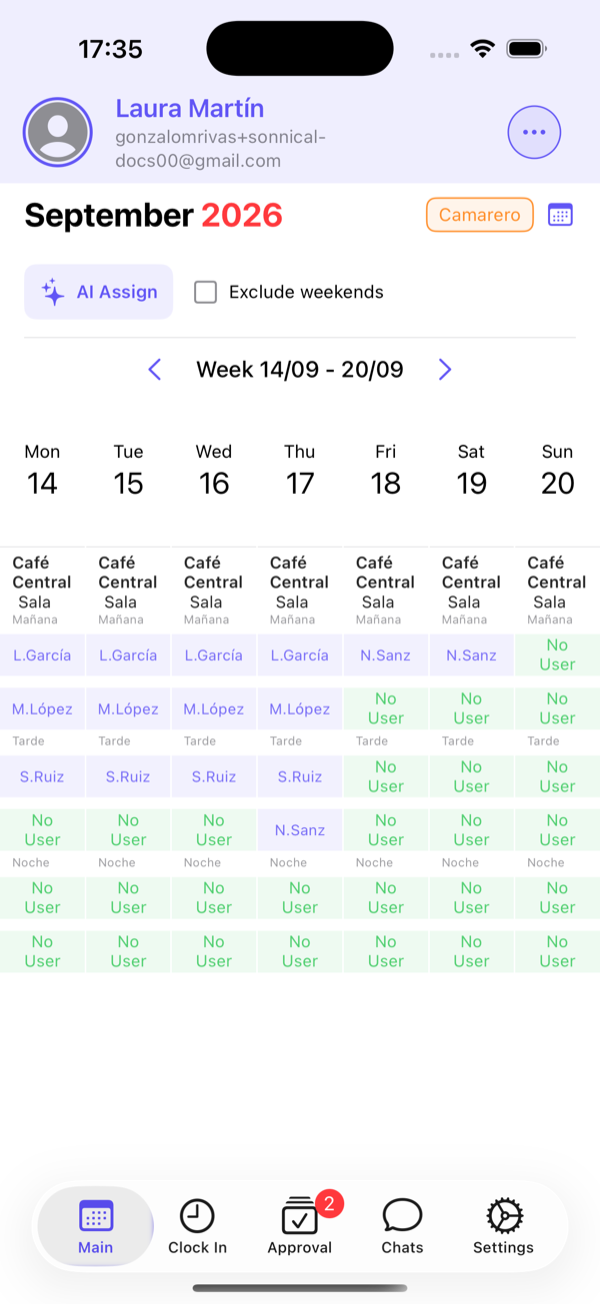
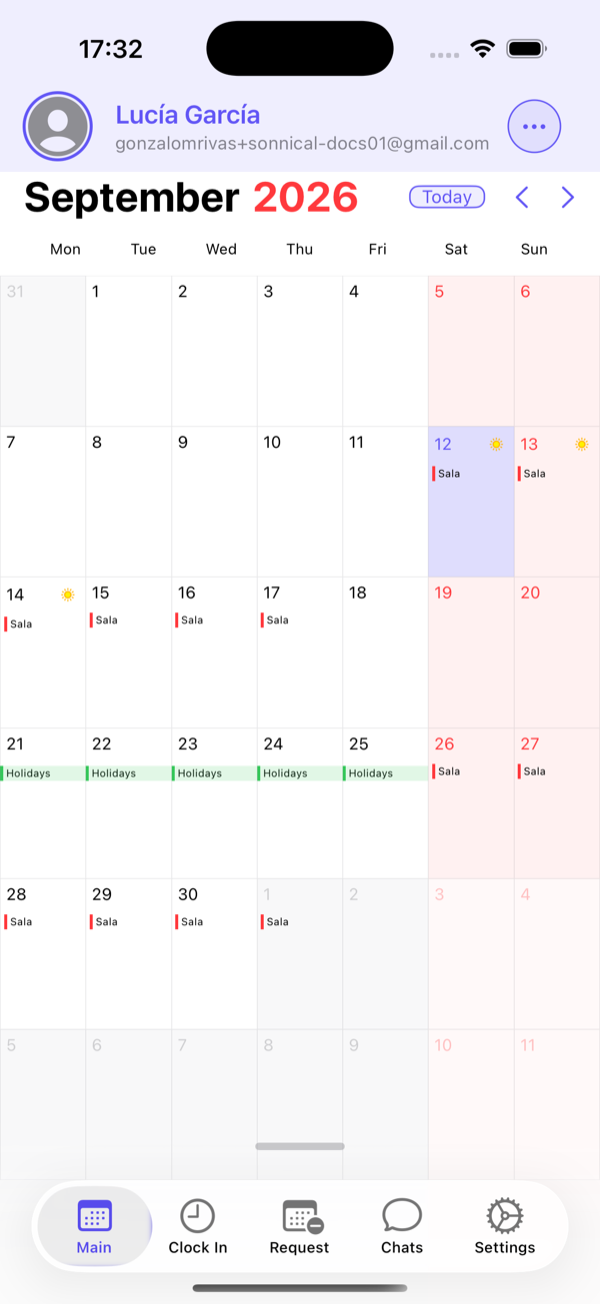
Swaps between colleagues are requested in the app and approved by you, with the hours already checked. Notices go out inside the app rather than in a personal chat. And the assignment knows everyone's contracted hours, so it will not quietly push someone over them.
For teams of up to six people it is free, which is roughly where the line we talked about sits. If your business is right at that point, trying it for a week costs less than building next month's rota.
Frequently asked questions
Is it bad to build shift schedules in Excel?
Not if the team is small. With five or six people on a single shift, a well-built spreadsheet is enough. Problems start with two or more shifts, rotations or part-time contracts: the sheet will not flag overlaps, it stops adding hours correctly, and every change means republishing the whole rota.
How long does it take to build a rota by hand?
Managers in hospitality and retail usually say four to six hours a week including corrections and messages. Over forty-eight working weeks that is 192 to 288 hours a year, which at £15 an hour of cost lands between £2,880 and £4,320 annually.
Can I run shifts through WhatsApp?
You can, but the management side should move out. Conversations live on personal phones outside company control, nobody is obliged to answer outside their hours unless on-call has been agreed, and adding someone to a group shares their number with everyone in it. A chat is a good place to talk and a poor place to publish rotas.
What if clock-in data does not match the rota?
Employers are generally expected to keep working time records that stand up to inspection, and in several European countries that duty is explicit and time-limited. The practical fix is to keep the clock-in and the planned shift in the same system, so the difference shows up the same day instead of at month end.